The complex questions of hormones and mental health


"That time of the month, love?"
[First published on Substack on 30 July 2023]
- Title: The Chemical Question
- Outlet: The Griffith Review, May 2021
- Length: 2500 words
- Turnaround time: Two weeks
- Number of interviews: Four
‘It’s my hormones, doc. It’s my hormones, and no one’s listened to that.’
This news feature for the Griffith Review – an Australia quarterly literary and current affairs journal – explored the effect that hormones have on mental health, why science is only now coming to the research party on this question, and what it means particularly for women whose hormonal ebbs and flows are more disruptive and destructive than most. It also addressed the sociological elephant in the room: if women are indeed at the psychological whims of their hormones, can we be trusted with power?
Idea
The idea for this started with a feature I wrote in 2019 for The Scientist – a US-based life sciences magazine – about two new classes of antidepressants that had recently been released.
One of these was brexanolone, the first ever treatment specifically approved for severe post-natal depression and which interacts with a hormone called allopregnanolone.
During separate interviews with two experts – Professor Jayashri Kulkarni in Australia and Dr Samantha Meltzer-Brody in the US – both mentioned how the link between hormones and women’s mental health had largely been ignored, despite their best efforts over their careers.
They commented that the development of brexanolone was evidence that, if this connection was taken seriously, it could lead to a new understanding of the interactions between hormones and mental health.
That stayed with me, and I wanted to revisit it in more depth. The opportunity came with a Griffith Review edition focused on the mind. I pitched it, and then-editor Ashley Hay said yes.
Interviews
The logical place to start for this story was with Jayashri Kulkarni and Samantha Meltzer-Brody, two scientists who had spent their lives pursuing this question of the interaction between hormones and mental health.
Kulkarni was a particularly interesting character for the story. She’s a world expert on hormones and psychiatry, and she founded and directs the Monash Alfred Psychiatry Research Centre.
Given she’d previously told me she spent much of her career working on this question, the first question I asked her was where that journey began. She told a poignant story about those women in the back ward of a psychiatric hospital, many of whom had been institutionalised for decades, who knew their psychosis was linked to their hormones but no one would listen to them. When Kulkarni took them seriously, and started a trial of oestrogen therapy, the results for some of the patients bordered on miraculous.
As soon as she painted that picture, I knew I had my lead. It so clearly encapsulated the theme of the story: the scientific and medical neglect of women’s health, and the cost of that.
I also wanted to go back to Samantha Meltzer-Brody, who had been involved in the clinical trials of brexanolone – the drug for post-natal depression – to dive deeper into the neurochemistry of it all. But with 2500 words to write, I was going to need more than just two interviews.
Reaching out to Jean Hailes for Women’s Health was an obvious strategy, because they’re a well-respected, evidence-based Australian organisation focusing on women’s health.
I didn’t have a particular expert in mind, so I asked their media unit if they could suggest someone with expertise in hormones and mental health. They came back with two names.
The first was Dr Rosie Worsley, who had expertise in pre-menstrual dysphoric disorder or PMDD, which is PMT so severe that women can be hospitalised on a monthly basis.
The second was Professor Jane Fisher, who the media contact said was happy to comment about these questions from a psychosocial perspective.
This was one of those serendipitous moments that occasionally happen in a story, where there’s an interesting and important angle you know is lurking just under the surface, but you’re not quite sure how to get to it. In this case, that extra dimension was the sociological question of what happens when you openly acknowledge that women’s mental health is affected, sometimes severely, by hormones?
It’s a proper can of worms, because it cuts to the heart of how women’s reproductive biology has been weaponised in the service of misogyny and discrimination for literally millennia: that old chestnut of ‘we can’t have a woman president because once a month she’ll want to go to war’, or the everyday casual cruelty of ‘that time of the month, love?’.
Kulkarni and Meltzer-Brody had both alluded to it; in Kulkarni’s case, mentioning that she’d experienced some pushback from feminist groups about her research and whether it was medicalising a ‘natural’ biological process.
This is a whole article in itself, and one I still want to write. But for this feature I had to try to distil that incredibly fraught debate into a few hundred words, while also conveying the nuance of it.
Fortunately, Fisher had an important perspective on the issue – arguing that we were at risk of medicalising things that were actually social problems to be addressed – that counterbalanced Kulkarni’s perspectives. It was a stroke of luck, as it would otherwise have been hard to find someone to specifically give a feminist analysis of scientific and medical research on hormones and mental health.
Altogether I interviewed four scientists, which relatively low for such a long piece. But I didn’t want to crowd the narrative with characters, and those four women each brought so much to the piece that I wanted to give them plenty of space to be heard.
Research
When it came to the research, I’d already done a lot of groundwork for the original The Scientist story, so I knew what some of the pivotal studies were and had a pretty good understanding of the science.
I also tracked down the original studies that Kulkarni published from her early clinical trials of oestrogen therapy in the women she encountered in the psychiatric hospital, which were also important for fact-checking.
Structure and writing
Normally for bigger features, I write out a dot-point list of all the possible topics and issues to cover, and alongside each dot-point I list the interviewees who have commented on those issues. If it’s a particularly complex piece, I’ll organise the topics into groupings that might sit together in the article.
But for this piece, I had been thinking about it for so long that it was lurking almost fully formed in my head. I knew the main beats I wanted to hit, and because there were only four interviewees, I had a pretty clear sense of where each character would fit with the narrative. I also knew from the start what the lead would be, after hearing Kulkarni talk about those forgotten women in the psychiatric ward.
I was keenly aware of the need to tread very carefully with the subject matter. There are lot of potential landmines when talking about mental health, especially in women and especially when you bring hormones into it, and I didn’t want to do harm by blundering through it.
So I wrote this story like someone walking a tightrope; seeing very clearly where I wanted to go, but placing each foot/sentence carefully and occasionally having to take a step back before going forward again.
Somewhat unusually for me, I also gave myself a decent amount of time to write it, rather than trying to smash it out the day it was due (editors, please ignore that sentence, I never do that for you), so I wasn’t rushing my thought processes.
Maybe because of that, and because I had thought through the idea so much, I was pretty happy with the end result. Of course, it would have been great to write more about the neurobiology, and dive deeper into the societal issues, but that’s the tyranny of the word limit.
Post-publication
I have to confess I had hoped this piece would make more of a splash than it did. I felt like it touched on something profound and important, and I kind of wished it had more of an impact.
But I think it’s also one of those slow-burn topics; it’s not some massive investigation that triggers royal commissions, but rather a deep societal issue that we are grappling with from so many angles. My piece was just another small part of that process.
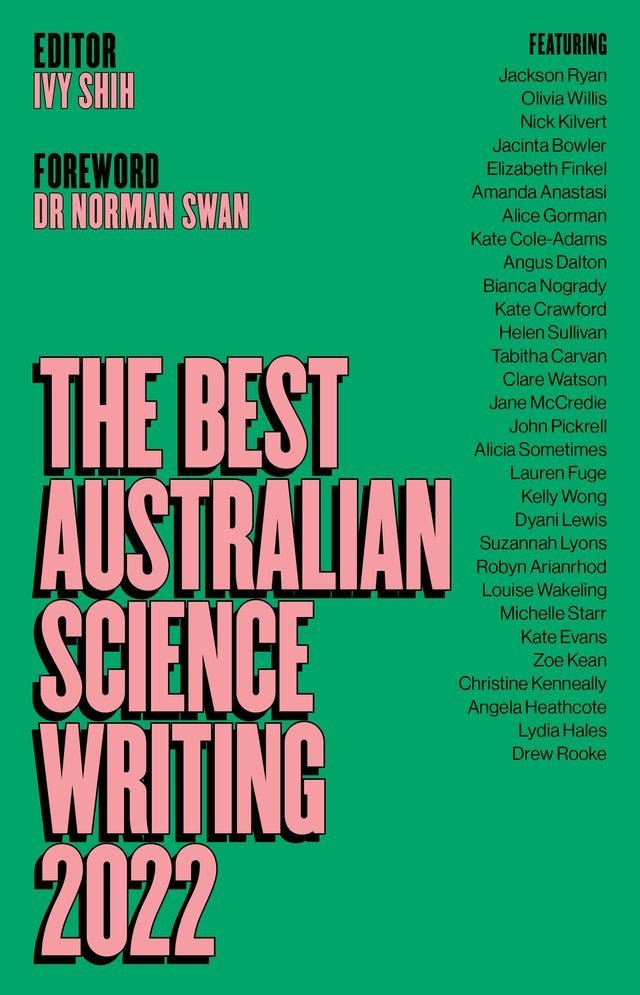
It did get selected for the 2022 Best Australian Science Writing anthology, which I was very happy about.
I have since written another feature for Nature magazine diving deeper into the scientific aspects of this story. It won’t be the last, as I feel like I’ve stumbled onto this subject just as it’s starting to get traction.
(This is my first crack at one of these posts, so if you have any feedback or comments, I’d love to hear them!)