Scientists under attack

"Eat a bat and die, b*tch" – documenting the parallel pandemic of online abuse of scientists.
‘I hope you die’: how the COVID pandemic unleashed attacks on scientists
- Outlet: Nature
- Length: 3300
- Turnaround time: Seven weeks
- Number of interviews: 22, including one by email, one anonymous, one who decided not to be included, and a few who didn’t make it into the story. There was also another who spoke to me on background only.
- Published: 13 October 2021
“It is very harrowing if every day, you open up your e-mails, your Twitter, you get the death threats, you get abuse every single day, undermining your work.”
Mid-2021, the pandemic was in full swing, the first round of Covid vaccines was rolling out around the world, but there were still way more questions than answers about this terrifying infection.
At the same time, the parallel infodemic – a surge in misinformation and disinformation – was bringing a storm of abuse down onto the scientific and medical community, from those who either didn’t want to hear what scientists had to say, or didn’t want others to hear it.
Nature asked me to report on this pandemic of abuse, alongside a survey they were conducting.
It remains one of the most important stories I wrote during the pandemic, and was the first of a series of articles exploring this issue and its far-reaching impact on science.
Why this story?
The idea for this feature came from the Australian Science Media Centre – a not-for-profit organisation that ‘works to enhance the media’s coverage of science’. Early in the pandemic, they surveyed the scientists they had on their books asking them about their experiences of online/digital abuse.
The results were shocking: a significant number of Australian scientists who were speaking publicly about their Covid-19-related work, either through media or on social media, were experiencing serious harassment and abuse, even threats of violence and death threats.
That survey caught the attention of Nature features editor Richard van Noorden. He was interested in whether there was a bigger story to be told, about how the pandemic was linked to a rise in online harassment and abuse of scientists.
Why now?
Online trolling, harassment and abuse burst into the public’s awareness with the online misogynistic GamerGate campaign against women in the games industry in 2014/2015. But scientists working on climate science, gun control, vaccination, myalgic encephalomyelitis/chronic fatigue syndrome and genetic engineering have been dealing with harassment and abuse for far longer than that.
The Covid-19 pandemic was – is – a once-in-a-century event that plunged the entire world into a nightmare from which we’re still waking up. When all of humanity is wracked with fear, anxiety, frustration, desperation, doubt and anger, those intense emotions are going to find an outlet. Or, some political leaders, media outlets, snake oil merchants, grifters and others are going to weaponise it for profit and/or ideology.
Scientists, doctors, nurses, and public health leaders were front and centre in the pandemic, so they were right in the firing line.
Where to start?
The Australian Science Media Centre’s survey was relatively small, so Richard was interested in expanding that dataset globally. Nature launched its own survey, asking similar questions about researchers’ experiences of media exposure and the aftermath of that. The survey went out through a range of networks, and in the end received around 320 responses from around the world.
Those responses confirmed the findings of the original AusSMC survey: that harassment and abuse of scientists was rampant, widespread, vicious and indiscriminate. It was targeting scientists who weren’t anywhere near the frontline of the pandemic; those working on mathematical models of disease spread, on fluid dynamics to explore how SARS-CoV-2 viral particles spread in a room, on meta-analyses of treatment studies.
That gave us the data, but to make this story work, it needed personal stories.
Interviews
Finding people who had already experienced online abuse, harassment and threats, and who were willing to speak publicly about it and risk attracting more online abuse, harassment and threats, was not easy.
Fortunately, there were a lot of potential avenues to find them.
Some were obvious because their harassment had already made headlines.
Some were word of mouth; colleagues who had heard of their experiences and told me.
Some were individuals who had responded to Nature’s survey and indicated they would be willing to talk more about their experiences.
Some were people I had seen tweet about their experiences.
Some were just high-profile scientists working in areas at high-risk of abuse, so I figured there was a good chance they had been targeted.
Some were researchers specifically looking at online abuse of scientists, and in one case who been a target earlier in their career.
Some were people I found by asking major scientific organisations and institutions’ media/communications offices.
I sent out a huge number of emails. Many went unanswered, but in the end I was able to do 22 interviews.
Not all made it into the story. Some were complicated by scientists torn between wanting to tell their story, but not wanting to openly criticise their institutions’ response to their abuse (which ended up being a story in itself). One would only speak anonymously and another only on background, because they feared repercussions from the internet mob.
Another complicating factor was some of the scientists I spoke to were controversial figures, and some were themselves accused of attacking other scientists and thereby contributing to pile-ons.
But even for those who didn’t end up being in the article, simply telling me their story was an act of great courage.
Scientists and science have always had a complicated relationship with science communication. It has long been recognised as a necessary evil: part of doing science is communicating the results, including to the general public whose tax dollars have often funded that research. But it is often viewed as a chore, something that is delegated to juniors or done as an afterthought.
Scientists who embrace science communication are sometimes given the side-eye as being show-boaters, attention-seekers, even *shudder* popularisers (this attitude was clear during the court case brought by microbiologist Professor Siouxsie Wiles against her employer, which I reported on).
The pandemic profoundly shifted that paradigm. Now senior scientists – heads of institutes even – were taking to social media and talking to journalists about the pandemic, because it was literally a life and death situation. But old attitudes die hard, and it was clear to me that some scientists who found themselves on the receiving end of abuse were wary of complaining or speaking up because they feared they would be blamed for bringing it on themselves.
I could write a whole essay – and many already have – about this tension between science and science communication, but that’s a story for another day.
Some internalised that, believing it was their own fault for being in the public arena. The experience of abuse was isolating, because they felt they were the only ones, that they had to deal with this alone. It’s well known that online abuse has profound mental health impacts, but so many of these scientists were thrust into this battleground with no awareness, preparation, resourcing or support.
So from me to all those who spoke up – bravo, and thank you.
Research
Because of the Gamergate saga, there was already a substantial body of literature and data on online abuse and harassment. Some researchers were also starting to pay attention to what was happening to scientists and public health officials. Plus we had the data from the Nature survey of an admittedly self-selecting population.
Unlike many other features I have written for Nature, this one was less about research and more about personal stories and experiences.
Structure and writing
My notes document, which contained interview transcripts, links, ideas, research sources etc, was nearly 72,000 words and 118 pages. It was a book. And I had to wrangle all that material into 3300 words.
Easy.
Not.
Here’s what the outline looked like:
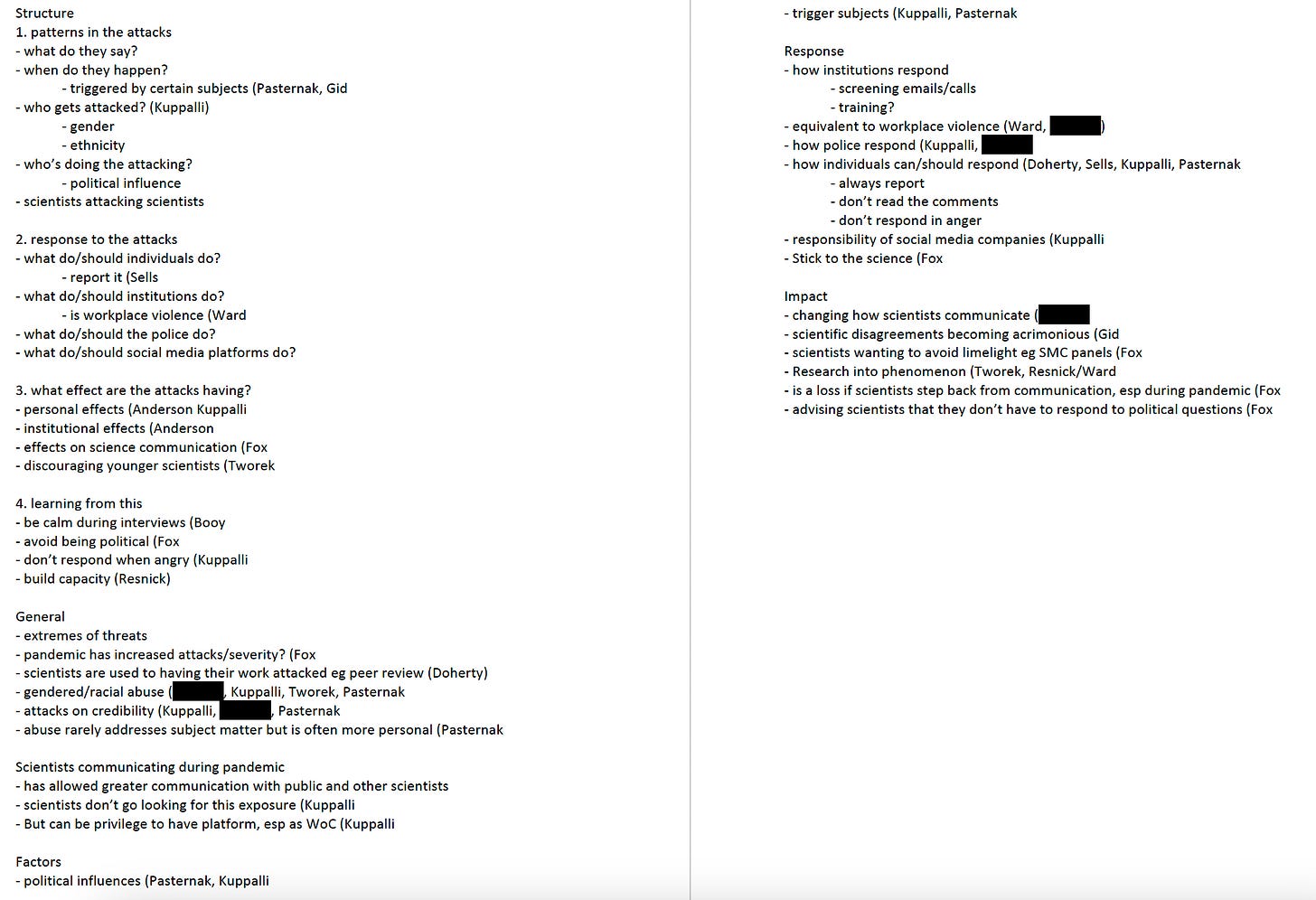
Writing this was agonising. There were so many stories to tell, so many points to convey, so many angles to explore, and I had so little space in which to do it.
The editing/subbing/fact-checking was BRUTAL. Nature is already one of the most rigorous fact-checkers I have ever worked with, but it was dialled up to 11 for this piece because there were so many sensitivities.
I have to give a shout-out to the Nature editors – especially Richard van Noorden, who deservedly got a reporting credit on the piece – for their incredible attention to detail, rigour and care with which they handled this story. It was haaaaaaard work, but it was worth it for the end result.
Post-publication
This was one of the most impactful and high-profile pieces I have ever written. It got major media coverage and Nature itself ran an editorial comment about the issue.
I received many emails – and still do – from scientists who have experienced or are experiencing abuse and harassment, and want to share their story.
In what I’m sure was no coincidence, someone tried to hack my Facebook account shortly after the article was published. This has happened multiple times since, and always coincides with me writing an article for Nature relating to online abuse and harassment (thank the gods for two-factor authentication). Richard had actually sent me some internal advice about how journalists could protect themselves from online harassment, which was helpful in preparing myself for the possibility I might find myself a target.
The article has also since sparked numerous follow-up pieces, like this one about Professor Siouxsie Wiles suing her university employer for failing to adequately support her during her online abuse; this one about how institutions could and should respond to online abuse of staff; and this one about digital safety and online security for scientists.
What did I learn?
Like so many who read this piece and saw Nature’s data, I was shocked by the scale and severity of online abuse and harassment of scientists during the pandemic.
Everyone was aware of the high-profile cases – Fauci, van Ranst, Hotez – but to hear stories from scientists who lost six months of their careers and lives to dealing with this scourge, just because they published a single meta-analysis, was gut-wrenching.
It was devastating hearing respected and admired senior female scientists tell me about being told their brain was ‘as empty as their c**t’. It was appalling hearing about younger scientists of colour being told to buy a gun to protect themselves. Scientists moved house, moved jobs, moved countries as a result of online abuse.
This parallel pandemic has cast a very long shadow over science and science communication.