Power down

How my electricity retailer's app led me down a grid-scale rabbit hole to discover why my state’s power network is in so much trouble.
Fossil fuels are unreliable backstops in the energy transition
- Outlet: The Saturday Paper
- Length: 1600
- Turnaround time: One week
- Number of interviews: Seven
- Published: 1 June 2024
“If you banked on things being $30 to $300 a megawatt-hour, and suddenly they're $10,000 for like a month, where do you get that money from?”
I’m often asked where I get my article ideas from. I usually joke, ‘any open space’ (which is a Spike Milligan war memoir reference, in case anyone cares).
But it’s true – my problem isn’t finding ideas, it’s finding time, editors and outlets to make them a reality.
This story is proof that story ideas can come from the most mundane of places; in this case, my electricity bill.
Why this story?
When we installed solar panels on our roof, the solar feed-in tariffs – the amount that households with solar panels were being paid for their solar electricity – were pretty crap. From memory, the most we could get from a standard energy retailer was around 10 cents per kilowatt-hour, but we were paying around 30c per kilowatt-hour to draw from the grid.
Then we discovered Amber, which is a NSW-based electricity retailer that sells us electricity – and buys our solar electricity – at the spot price, which is the wholesale price that retailers buy electricity at. This price fluctuates minute-by-minute according to supply and demand. High supply, low demand means power is cheap; high demand and low supply drives up prices.
One of the advantages of this system is that we can monitor electricity prices throughout the day – including the amount supplied to the grid by renewables – and tailor our electricity use to make the most of that; for example, choosing to charge our EV or put on the dishwasher when prices are low.
Occasionally, there are price spikes, where the spot price surges from the usual 20-50c/KWh to dollars per KWh, sometimes in the tens or twenties, for an hour or so. Usually those happen during times of extraordinary demand, such as heat waves, or if there’s a sudden shortage of supply, like if a major power station unexpectedly goes offline.
And that’s what happened that ordinary autumn day in 2024. The spot price skyrocketed to $17/KWh and stayed there, hour after hour, through the night and into the next day. Amber was issuing warnings to customers via the app and by email to reduce their usage to save money.
Finally the Australian Energy Market Operator (AEMO) stepped in and imposed a price cap; something they rarely do. There was a sense that something had gone seriously wrong with the NSW electricity grid and market. I wanted to know what and why.
I did some reading around and research, spoke to someone from AEMO on background, read some other reporting, and realised there was a bigger story here about the vulnerabilities that climate change and the renewable energy transition were exposing in the grid.
The pitch
Here’s the pitch I sent to The Saturday Paper:
“You're probably kicking back after putting the paper to bed, but I wanted to pitch this while it was fresh in my mind.
The Australian Energy Market Operator took the very rare step of intervening to cap energy prices in NSW this week after they shot up to around $16,000 per megawatt/hour (compared to $100-$250 in the other states) and kept spiking for 24 hours. This cap has only been implemented once before in AEMO's history.
But this wasn't simply a case of high supply and low demand; in fact, demand was relatively low, and there was more than enough supply to meet it.
What had happened was that two coal-fired power units unexpectedly went offline - representing around 3 gigwatts of capacity - at the same time as some transmission lines were offline for maintenance. That brief shortage gave other suppliers free reign to increase their prices, and the market went haywire.
A person from AEMO told me on background that it was basically price-gouging, but was essentially within the market rules for the way the energy market is set up. But it has significant downstream consequences for any business paying wholesale electricity prices: before the cap was imposed, prices were hitting $17/kilowatt-hour (compared to $0.30-0.50 per kWh during typical peak demand periods).
I noticed the spikes because our home power comes through Amber – a retailer that charges wholesale prices so we can adjust our electricity use according to hour-by-hour prices. On Wednesday 8 May, we paid $80 for a single day's worth of electricity use – more than ten times what we usually pay.
While this might be a rare event, it raises the question of whether the current market set-up for energy prices is fit for purpose, particularly during this period of flux as the ageing coal-fired power fleet starts to wobble but Australia has not yet got enough storage capacity to meet baseline demand from renewables.
I think this is an issue to explore: how does our energy market need to change as Australia navigates the transition from coal to renewables?
The price cap has had a bit of coverage in the Fin Review and there's an analysis in Renew Economy today. I think [another environment journalist] was sniffing around AEMO but don't know if he's planning to do anything on it.
Anyway, let me know if you think it's worth a visit. And have a good weekend.”
Where to start?
I had already done an interview on background – not for quoting or attribution – with a spokesperson from AEMO, which meant I had a very VERY basic understanding of the issues. But the Australian national and state energy grid and markets are seriously complicated, highly regulated, and it would take a degree in energy economics to really understand them at a deep level.
I just had to understand them enough to make sense of what was happening, why it was happening, and to work out what readers needed to know.
I already had comments on background from someone at AEMO, so I got back in touch with them about getting some comments on the record. I also contacted the Australian Energy Market Commission, the Australian Energy Regulator, and found a range of other experts at organisations like the Victoria Energy Policy Centre and Macquarie University’s Centre for Transforming Energy Markets. I found others because they had written about the issue for places like The Conversation or had published research papers on Australian energy market regulation.
I also approached Amber and a couple of other electricity generators and retailers, and sent questions to the federal Energy Minister Chris Bowen (whose spokesperson responded with a statement by email, which is now the frustrating default for any questions put to government ministers and agencies).
Interviews
Because I knew very little about how Australia’s electricity grid and markets worked, I relied heavily on my experts to explain it to me. Thankfully they were all very good at doing that, because it wasn’t straightforward or intuitive. With each interview, my questions got more and more specific and targeted as my understanding of the complexities grew. And I kept asking questions until it made enough sense for me to explain it to the audience.
The regulation alone was complicated enough. I have written in my notes, “AEMC makes the rules, AEMO keeps the lights on, AER is the police”, which didn’t come from an interview, so it was one of those lightbulb moments where I have a flash of clarity and have to write it down before I forget it!
By the end I had around 22,000 words of interviews, statements and background comments to work with, for a 1600-word story.
Research
Most of the research for this involved trawling through the various regulatory authority and government websites, reading press releases, looking up records for wholesale spot prices, and reading research and opinion pieces about the grid, market and regulation.
One vital source of information was this news story on Watt Clarity by Paul McArdle, which really helped me to understand what was going on.
Structure and writing
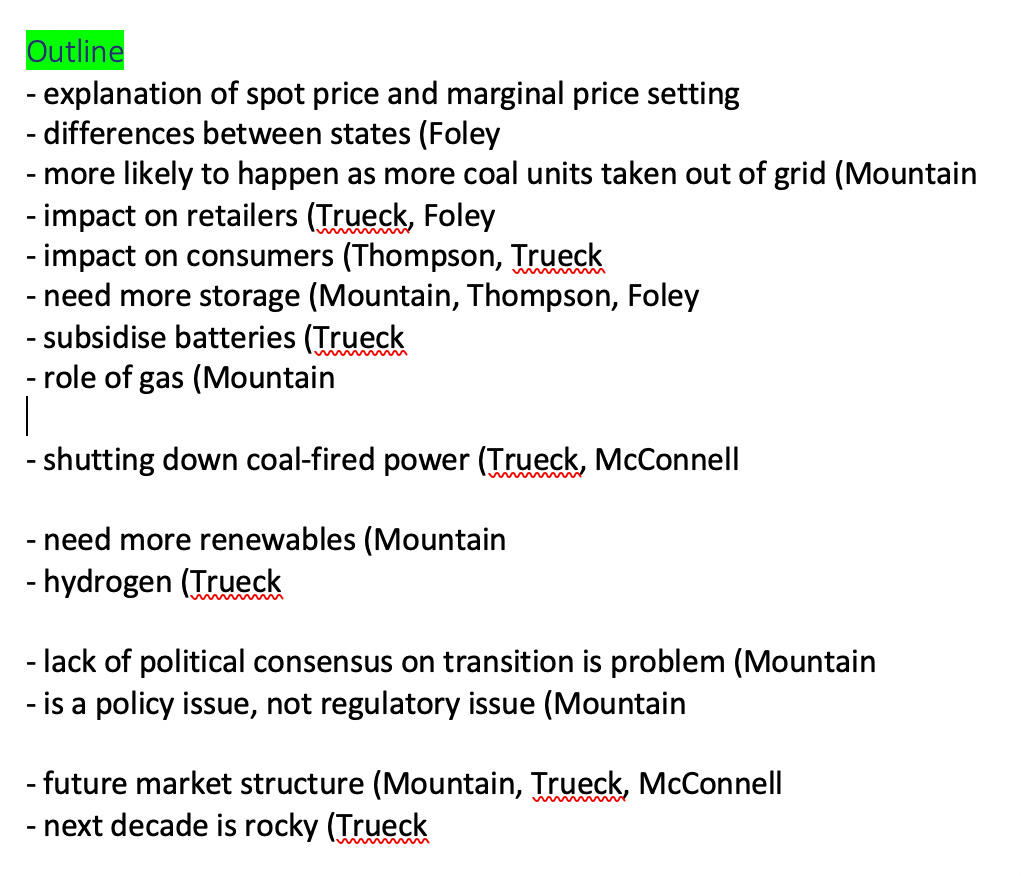
Because of the complexities of the electricity market, I knew I’d have to spend a fair number of words spelling out how the whole thing worked, before evening getting to what went wrong, why it went wrong, and what it all meant for the future of the grid. Around one-quarter of the story is explanatory (which is why I am a huge supporter of awards that celebrate explanatory journalism, because it is hard work).
Here’s what the planning outline looked like:
Post-publication
As so often happens with stories I think are terribly important, nothing much happened. But I like to think that whoever read it might have come away with a bit more understanding of why the electricity grid is currently so vulnerable to these huge and costly perturbations, and what we should be doing about it.
It also turbo-charged our desire to get a battery installed to complement our solar panels, which we have now done.
What did I learn ?
I learned a hell of a lot about the national energy market, the electricity grid, and what’s happening when our electricity price spikes (which it still does about once a week, although not nearly as high or for as long as that one time). I now get the AEMO press releases, and keep an eye out for anything that might suggest more trouble is on the way.
It also reminded me why I love science and environment reporting so much. I get a huge buzz out of learning how stuff works, even something as seemingly boring as energy markets.